


I build tools for writers. Every day, my agentic pipeline scans a few thousand Substack stories and decides which ones deserve attention. Claude, used as the final LLM-as-judge, is costly: some $3 per batch of 70 stories.
This is why I looked at Jev: a decision model that cannot produce text, but can make decisions, and it : $0.042 per million tokens. Could Jev replace Claude? Read below.
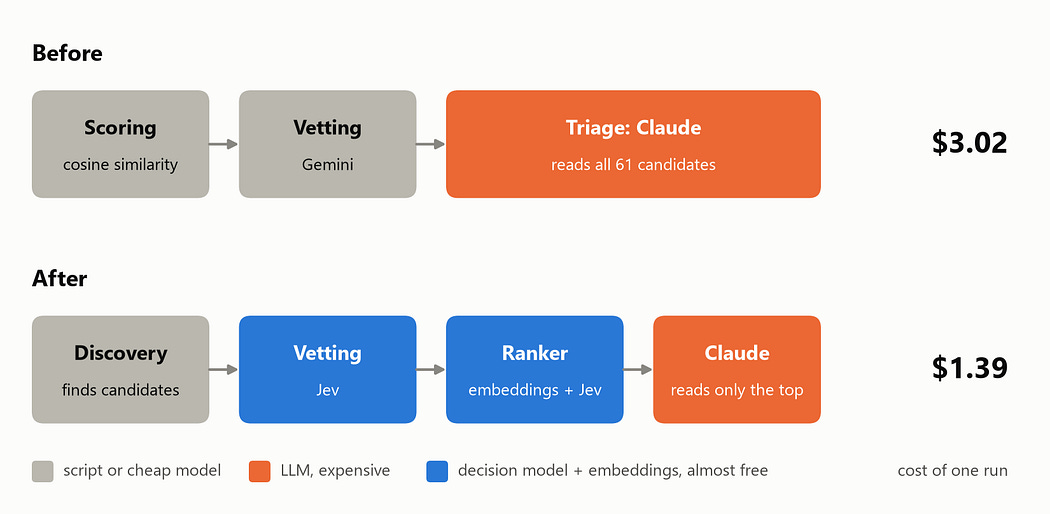
My pipeline, before and after learning to use Jev
What my pipeline does
I’ve been working on analytical tools for authors who publish on Substack and Medium. While Medium promotes posts automatically, relying mostly on its discovery algorithm, Substack is more relationship-driven: writers are expected, and encouraged, to engage with each other. So my tools help authors find other, kindred authors to engage with. You will find some details on the mechanics of my scripts in my older stories: “Who wrote similar?” and “Evaluating Retrieval Without Ground Truth”. Since then, the toolset has grown into a number of agentic pipelines working daily over a large database of blogs.
The idea is simple. Take the author’s recent story, search Substack for stories with an intriguing similarity to it, and propose them to the author, who may then decide to engage with the other authors. Teaming up with another, kindred author can have mutual benefits: commenting or recommending each other has more value if the interests of both audiences overlap. So the script crawls the blogosphere and identifies candidate stories, ranked by cosine similarity and a few other factors.
But cosine similarity is a “shallow” metric. It captures shared words and themes, but not well the deep, underlying ideas. Here is an example. One of the blogs the pipeline serves is Nomadic Mind, a travel blog. Its series “Where Europe Still Dances” explores the experience of the traditional French dance balls. On the other end of the blogosphere, another author wrote “Why Making Music Together Feels So Good” — explaining the concept of participatory music making, featuring a Chilean teacher performing Depeche Mode for his class. Both stories are kindred, similar in spirit. Their underlying theme is the joy of participating in music together. But the cosine ranker missed that deeper connection and ranked the similarity low. The vocabulary of both stories doesn’t really overlap, and France is so far from Chile…so the cosine similarity fails.

My architecture so far
This is why the cosine ranker, a bit dumb, is only a preliminary ranking. My pipeline, until now, was:
scoring: cosine similarity of embeddings
vetting: a cheap model, Gemini 2.5 Flash or Claude Haiku, filters out unwanted topics
triage: Claude, expensive, acting as an LLM-as-judge, making the final decision, often overturning the initial judgement.
On the test run, 492 articles were scored. The vetting filtered out most of them, and the remaining 61 went to Claude. Claude triaged them, rejected most and eventually selected 18 fair and 9 highly promising candidates for an engagement. The prototype pipeline works well.
Except it costs $3.02 per run, most of which are Claude tokens.
My pipeline sits on Databricks, ready to be parallelized as multitenant Spark jobs, run for many users at once, simultaneously, and regularly. There is nothing blocking it technically, except the prohibitive cost of tokens. Too high — by two orders of magnitude.
This is when decision models caught my attention.
Jev, a model that cannot write
While an LLM produces text, a decision model produces, you guessed it, a decision. Conceptually, it’s like a good old classifier: “Look at this picture. Is it a human? Is it a bicycle?” But it’s better: modern decision models are built on transformer architectures, so they accept text as input. Still, the output is not text.
Jev comes from TypeSafe AI, a San Francisco lab founded by Diogo Almeida, a former OpenAI researcher. On 15 September 2026 it was released and marketed as “System One Model”, after System 1, the fast thinking in Daniel Kahneman’s famous book Thinking, Fast and Slow. All of a sudden everyone was talking about it. Vercel added Jev to its AI Gateway on the second day, and reported that nearly 13% of its paid teams tried it within 24 hours. Welcome to the world where things happen faster than we’ve been used to…
Also OpenRouter added Jev to its collection. OpenRouter is a public gateway that provides a uniform interface to many models. So I used Jev through OpenRouter.
How does Jev work in practice? It is simple. In a JSON document, you ask Jev a question, with some context (text). The questions can be of three types:
Choice: “Is this email intended for sales, invoicing or complaints?”
Score: “Rate this student between 0 and 100”
Noul: “Provide probability that a statement is true.”
Here below is an example request I was sending, shortened. In the first question (choice), I am asking to classify the story. In the second (noul), I am asking if the story is politically biased.
{
  “model”: “typesafe/jev-1.14”,
  “state”: “Title: ...\nSubtitle: ...\nBlog: ...\n\n(the first 3,000 characters of the article)”,
  “questions”: {
    “topic”: {
      “type”: “choice”,
      “instructions”: “What is the main topic of the post?”,
      “criteria”: {
        “travel_places_cultures_abroad”: “Travel, specific places, other cultures, or living abroad”,
        “partly”: “Touches on travel or places but mainly about something else”,
        “other”: “Not about travel, places, cultures or living abroad”
      }
    },
    “political”: {
      “type”: “noul”,
      “instructions”: “The post takes one political side as unquestioned fact, uses derogatory labels for political opponents, or is written for one political camp. A post that discusses politics, policy or political events analytically does not count.”
    }
  }
}
And here is the answer:
{
  “topic”: { “choice”: “partly”,
             “probabilities”: { “travel_places_cultures_abroad”: 0.02, “partly”: 0.90, “other”: 0.08 } },
  “political”: { “noul”: 0.92 },
  “usage”: { “input_tokens”: 1249, “cost”: 0.000052 }
}
This approach has tremendous advantages. First, it is fast and cheap: the call above cost five thousandths of a cent. Secondly, it radically simplifies the architecture. Many guardrails become unnecessary: since text is not part of the output, it cannot be toxic, harmful or adversarial. Also, prompt hacking has a smaller effect. An attacker can, at most, influence or bias the output categories.
TypeSafe even claims that Jev “can’t hallucinate”. I don’t know about that. Jev’s architecture has not been published. As Armin Ronacher put it, the design “delegates the hallucination problem a little bit to the user”.
I realized quickly Jev could solve two problems at once: reduce cost and simplify architecture. Could it also improve the results?
Jev judged bias better than the LLM
Now, I need to explain why I need the vetting phase.
In the process of identifying kindred stories, I learned that embedding similarity paints only part of the picture. Especially in the American blogosphere, there are two particularly nasty types of texts that pass unnoticed through the embedding sieve: politically biased and religiously biased ones. They use similar wording and similar themes to the target story, yet they are far from “kindred”.
Take France. Nomadic Mind has a story called “Paris: Propriety and Urban Rebellion”, in which its author boards a train to a clandestine anarchist meeting in a Parisian suburb. Its tone is playful, tongue-in-cheek. The embeddings ranker did not get the humor and rated the story closest to “What’s Really Going on in France?”, written by Nick Griffin, the former leader of the British National Party, blaming the recent riots on the far left. One story is sarcastic, the other is political, but they were rated alike for similar vocabulary. The similarity ranking was initially driven by 384-dimensional embeddings of MiniLM over Chroma. Increasing the dimensionality to 768 (replacing MiniLM with all-mpnet-base-v2) did not help either. Possibly, scaling further to deeper models with 3K dimensions would change something, but that is outside my options.

Religion bias works the same way. Nomadic Mind has a story from West Africa, where its author listens to people who believe in the devil of the forest. The story landed close to various obscure conspiracy theories explaining how the magical operations of freemasonry hidden lodges lead to control of the Global Elite. Both stories speak of the devils, but the authors are very unlikely to want to engage mutually: the first author looks at the phenomenon as folklore, the other one honestly believes in the paranormal and takes religious stance.
This is where the vetting comes in. In the second phase of the pipeline, I used a cheap model, Gemini or Haiku to filter out various unwanted features of the candidate stories. Among them, importantly, I wanted the politically and religiously biased texts out.
Could the vetting model be replaced by Jev?
I sent the same 492 articles to Jev asking it to do the same job. To my disappointment, it flagged only 16 articles as political, and 5 as religious (as opposed to Gemini, which earlier had filtered out over 100 for bias). I thought Jev was wrong, so I reviewed what was happening, and it turned out that the initial sieve had been wrong! Gemini (or Claude Haiku) classified stories as “political” when they just spoke about politics. Jev was sharper for the price: it distinguished political topic from political bias. It wasn’t perfect, but it was better: when I manually ranked stories for political bias, it agreed with me 21 out of 24 times.
All in all however, the effect on my most important parameter (cost in dollars) was bizarre: even though Jev was generally more effective, we ended up filtering fewer stories, not more. Not good! Our goal was to filter early as much as possible, so that the LLM phase would focus on fewer stories and be cheaper. Instead, it got pricier. So I looked at the more interesting part: could Jev replace the LLM in the third phase (triage)?
Jev for triage
Triage (phase 3) was the most expensive phase. The model, LLM-as-judge receives only the best stories as input, and makes the ultimate verdict: which story is most similar to ours, and which author is worth engaging with. Here, we need an expensive model (today, Claude Opus). Cutting the cost of this phase would have the highest effect.
I first tried to bluntly replace the LLM-as-Judge by Jev. This failed. Claude understood the context and nuance better. On the sample of 52 stories a human ranked top, Claude agreed with 40, while Jev agreed with 17. But this gave me an idea. Seventeen, which comes almost free, is already something. Could I use Jev to better rank stories, so Claude could just read the top of the list and burn fewer tokens?
So far, I only used Jev to filter out political and religious bias. Wrong. He could do more.
Here, I used Jev’s Noul-type query. The goal was to understand whether a candidate article had an interesting angle relative to the author’s story. So I asked Jev a simple question: “Would the author of story A be interested in commenting on article B?” A Noul yes/no answer carried probability, which I later interpreted as score. (technical note: it could be more natural to use Jev’s native Score-type query, but somehow I was unsuccessful in it. The requests were blocked, probably at OpenRouter’s API level. Whatever. Probability of True was good enough.)
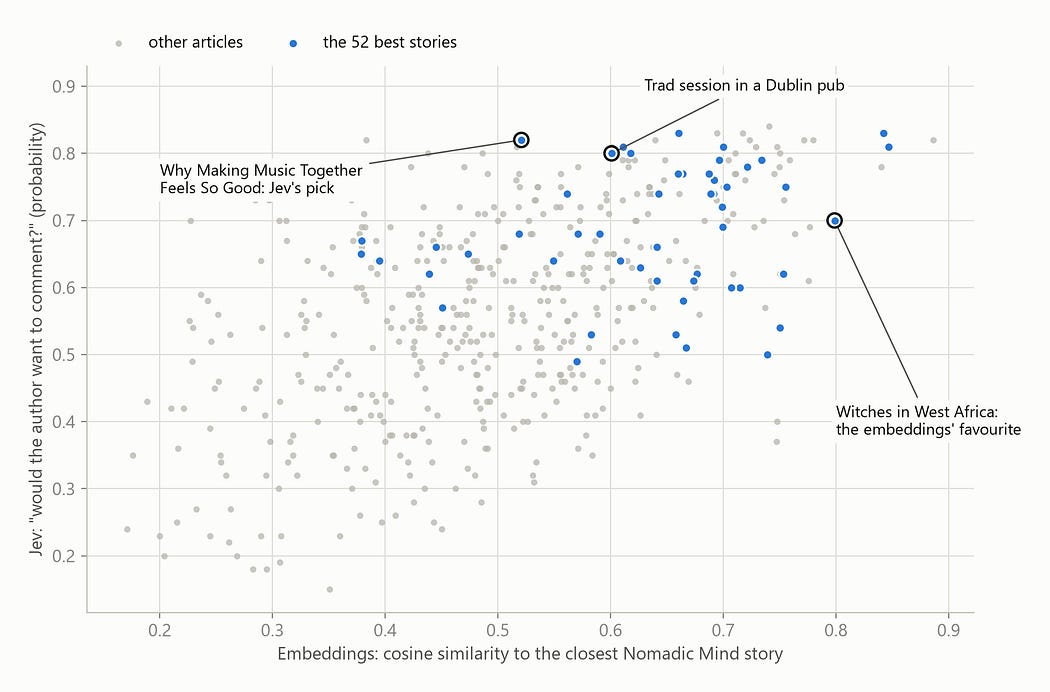
Jev’s scores were promising, but not great. It ranked somewhat better than embeddings, but not well enough to replace Claude. Initially, the numbers looked poor, confirmed by the visualization below. Both rankers correlated poorly with each other, and also with human judgement. If they did, the blue dots on the diagram below should sit in the top right corner, where they are not.
Two rankers, two kinds of kinship
But a seasoned data scientist learns to distrust numbers. I dived deeper and saw something intriguing: the two rankers ranked different kinds of articles high.
The embeddings found kinship in vocabulary, but this included location and subject. “The women banished as witches in West Africa” scored 0.80 against “How the Witch Saved Aisha’s Baby”, Nomadic Mind’s story also set in West Africa. Jev instead found kinship in ideas. He correctly decided that an Irish music session in a Dublin pub was related to a sagra (village festival) in Puglia, southern Italy.
Once I understood this, the solution was straightforward.
I tweaked some things, and hacked an algorithm that blended both rankers (score fusion) — copying the idea of machine learning models ensemble: “can a set of weak classifiers create, as an ensemble, a powerful classifier?” Yes it can:
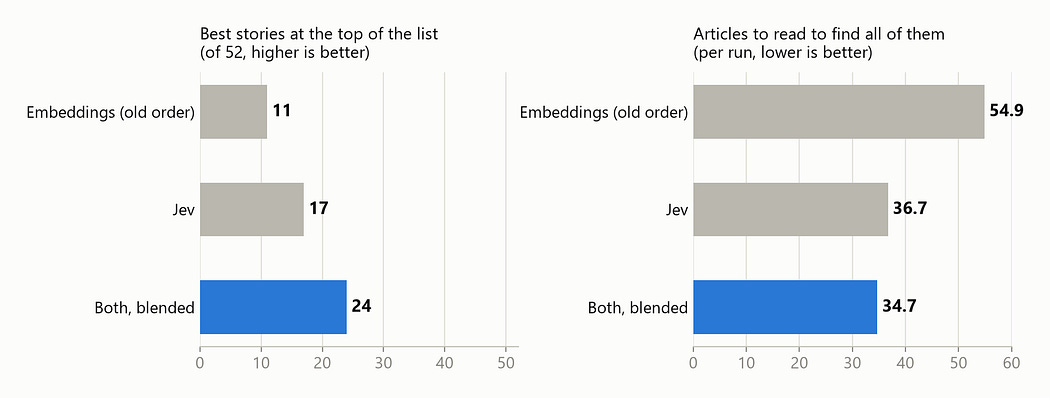
Blended ranker is better than both Jev and Embeddings alone
The new architecture
So we have built the final architecture:
Discovery. The script finds candidate stories, as before
Vetting. Jev filters out biased posts and other unwanted categories
Ranker. The embeddings and Jev, blended, tell Claude what to read first
LLM-as-judge, only on the top of the list. Claude is still there, but he reads only very few articles, so he is much cheaper.
Performance? Twice as good as before. At the top of the list, Claude used to find 11 of the 52 best stories. Now he finds 24.
Cost? $3.02 dropped to $1.39. Claude no longer loads a list of 60 to 90 articles into its context, but reads only the very best candidates and stops. This is still too expensive, but it defines an avenue for further tuning and cost saving. I have a number of ideas how. Hint: Jev’s part of today’s $1.39 cost is $0.02 (yes, two cents)
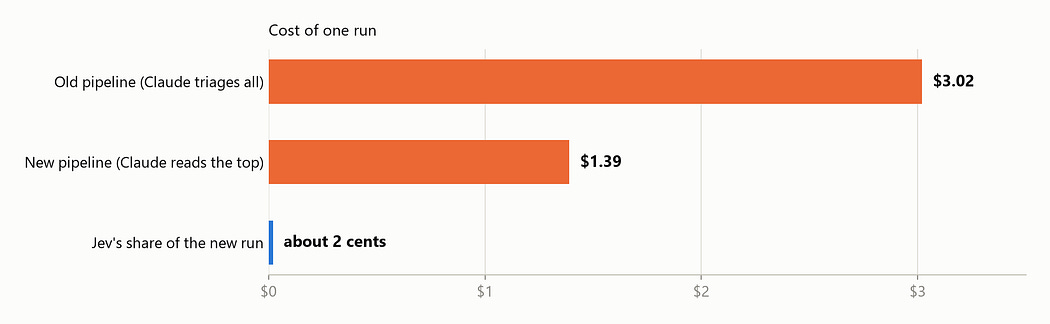
Architecture? It is not only simplified (less worry on LLM guardrails), but also it became ready to scale over Databricks, enabling multitenancy over massively parallel runs that scale not only technically, but also financially.
Are decision models (like Jev) a game changer?
Yes. For bounded questions, I believe they are. And, as this project shows, many problems can be redefined as such.
Jev could not replace Claude as the judge. But on bias, it was better than cheap LLM, and as a ranker it let Claude read much less. Per article, it was 130 to 180 times cheaper. The cheap layer already costs almost nothing: what remains is Claude’s reading. Jev writes no text, so fewer things can go wrong and output processing is simpler, although its answers can still be wrong. This fits a pattern that is becoming common in AI engineering: a cascade, or model routing, where cheap “System One” models make the fast decisions, and an expensive LLM is called only sparingly.
Jev is not alone. Since it launched, several alternatives appeared. For instance, Remigiusz Kinas published Basal, a small model (1.5 billion parameters), fine-tuned from the Polish model Bielik, and free under the Apache 2.0 license. In its author’s benchmark, it beats Jev. Then came Cloudflare’s Clef, OpenAI’s Decisions API, and Fastino’s GLiNER2.5-Decide. I tested only Jev, not because I found it superior, but because I wanted to test the concept: decision model instead of LLM-as-judge.
Decision models such as these, together with sentence-transformers and a vector database such as my Chroma, are the base for the cheap layer. Then, the LLM-as-judge reads only what is worth reading.
Thank you for reading. Do share your take.
An earlier version appeared in Data Science Collective on Medium, October 2026.

Great use-cases for JEV. I also think Jev and other Decision Models are game-changers. One note though, for your pipeline, you have to consider the low-confidence scores. One thing Jev is not doing (yet) is not providing a reason for the confidence score. So in your workflows you need to consider this in terms of reliability of the reply.
Have you considered using post metrics in your pipeline?
Many platforms like Substack shows public metrics (likes, comments, restacks) and these provide “human ranking” signals that could even cheaper classification in the beginning of the pipeline.
For example, stories with a lot of comments resonated enough for readers to actually write back. Or stories with a lot restacks are the ones readers want to share with their circle of friends.
Keeping these human generated signals can be useful depending on what your end goal is with the final product you are building here.